
logo-oibr
  • OIB
    • About
    • News & Analysis
    • Director's Yearly Address
      • Vorwort des Direktors 2024
      • Director’s Address 2024
      • Vorwort des Direktors 2023
      • Director’s Address 2023
      • Director's Address 2022
      • Vorwort zum Jahresbericht 2022
    • Advisory board
    • Josef-van-Ess-Memorial-Lecture
    • Annual Reports
    • Newsletter
    • In the Media
    • Gallery
  • Events
  • Library
    • About
      • Library Team
      • History
    • OIB Catalogues
      • GoTriple
      • OPAC
      • IPAC
    • Repositories & databases
    • Online registration
    • Collection
    • OIB Library Regulations
  • Research
    • Current projects
      • The Japanese Red Army in Lebanon: Solidarity, Militancy, and Transregional Connectivity (Claudia Derichs)
      • Catastrophe, Memory & Critique
      • The ABC of Abū Bakr al-Shanawānī (d. 1610). Arabic letter semiotics on the threshold of modern times (Berenike Metzler)
      • Discourses on Statehood in Iraq (Christian Thuselt)
      • Decolonization, Cold War and the Rise of Authoritarianism in the Middle East (Carol Hakim)
      • A Literary History of Arab Futures: Enlightenment, Ruins, and Dystopia (Zeina Halabi)
      • Kant and the Non-European: Critique, Justice and Freedom
      • Global Weimar – Global Nahda (Princeton University and Orient-Institut Beirut Cooperation)
      • Critical Theory from the Global South: New Perspectives from Beirut (Sami Khatib)
      • Women and religion in post-conflict societies (Stephanie Dornschneider-Elkink)
      • From Arabic to Latin: Moving sciences of music around the Mediterranean (Rosy Azar Beyhom)
      • Abrahamic Interdependence - Relationship of the Islamic to the Jewish in Marital Law (Ahmed M. F. Abd-Elsalam)
      • Lebanon’s Art World at Home and Abroad: Trajectories of artists and artworks in/from Lebanon since 1943 (LAWHA) (Nadia von Maltzahn)
      • The New Testament quotations in Ibrahim al-Biqāʿīs (st. 1480) commentary on the Koran (Thomas Würtz)
      • BALANCE AS JUSTICE: DECONSTRUCTION OF PREMODERN ETHICS ON THE BASIS OF ḲINĀLĪZĀDE ꜤALĪ ÇELEBĪ’S AKHLĀḲ-I ꜤALĀ’Ī (FATIH ERMIŞ)
      • From Copying to Burning the Qur’an: Creating Models & Transposing Sacrality (Alya Karame)
      • Living in Limbo (Sarah El Bulbeisi)
      • Escape to Europe: Comparative Refugee Imaginaries (Markus Schmitz)
    • Previous projects
      • Cultural Policies in Lebanon: Cultural Institutions between State and Society (Nadia von Maltzahn)
      • Fictio Statis (Pierre France)
      • The Lebanese Intifada of October 17: Perspectives from Within (Birgit Schäbler)
      • Relations in the Ideoscape: Middle Eastern Students in the Eastern Bloc (1950's to 1991) (Birgit Schäbler)
      • Europe and the Middle East (Birgit Schäbler)
      • Picturing the (Un)Dead: Reflections and Deconstructions of Lebanese and Iranian "Martyrs" in Contemporary Photo-Related Art-Practices (Agnes Remeder)
      • Hierarchical Rationality of Religious Beliefs System in Islamic and Christian Theology (Qodratullah Qorbani)
      • The inimitability of the Qur’ān (i‘jāz al-qur’ān) in transconfessional contexts of the early ῾Abbāsid period (Hans-Peter Pökel)
      • Cultural Mobilities and Political Spaces (Christopher Bahl)
      • Al-Qadi al-Fadil (Stefan Leder)
      • Bedouin Syria (Johann Büssow)
      • Borrowing and lending (Jonathan Kriener, Ruhr-Universität Bochum)
      • Clergy and conflict management (Thomas Scheffler)
      • Higher Education and Citizenship in Egypt (Daniele Cantini)
      • History Writing at Lebanese Universities (Jonathan Kriener)
      • Knowledge in postgraduate studies (Daniele Cantini)
      • Mamâlik – Spatial Dynamics of Islamic Polities (Kurt Franz)
      • Media culture transformation (Hanan Badr)
      • Museums in Dialogue with the Future (Felicia Meynersen)
      • Political slogans (Nader Srage)
      • Political thought (Stefan Leder)
      • Rural societies in an age of urbanisation (Astrid Meier)
      • S.C.R.I.P.T. - Source Companion for the Research on Islamic Political Thought (Stefan Leder)
      • Talking about art – aesthetic reflection in Egypt and Lebanon (Monique Bellan)
      • Tracing an author’s library (Torsten Wollina)
      • A Literal World: Perceiving the World as a Linguistic Construction before the Emergence of the Metaphor in Arabo-Islamic Thought (Abdallah Soufan)
      • Open Arabic Periodical Editions (OpenArabicPE) (Till Grallert)
      • “Women on the streets!: a genealogy of food riots in the Middle East between the 18th and 20th centuries“ (Till Grallert)
    • OIB Seminar Series
      • Theory & Method Seminar (Zeina Halabi) By invitation only
      • The OIB Colloquium (Carol Hakim)
      • The Lebanese-Syrian Studies Colloquium (Carol Hakim)
      • The Egyptian Studies Lecture Series (Carol Hakim)
      • The Hans-Robert Roemer Fellow Lecture Series (Jens Hanssen)
      • The OIB-LAfOS Annual Lecture On Lebanese-Ottoman Studies (Jens Hanssen)
      • The Annual Joseph-Van-Ess Lecture (Jens Hanssen)
  • People
    • OIB Team
      • Directorate
      • Administration
      • Library
      • IT
      • Publications
      • Research Associates
      • Cairo Office
      • Fellows-in-Residence
      • Technical Staff
    • Academic Visitors
      • Hans Robert Roemer Fellow
      • Affiliated Researchers
      • Fellows-at-large
      • Journalists-in-Residence
    • LAWHA Team
    • Alumni
  • Publications
    • BI · Bibliotheca Islamica
      • About BI
      • Recent Issues
      • Full List
    • BTS · Beiruter Texte und Studien
      • About BTS
      • Recent Issues
      • Full List
    • OIS · Orient Institut Studies
      • About OIS
      • Recent Issues
      • Full List
    • OIB Blog
    • Extra Series
      • About
      • Recent Issues
      • Full List
    • Latest Publications
  • Academic Support
    • Calls & Grants
      • Call for papers: The Arab Graduate Students Conference (AGSC), organized by the Arab Center for Research and Policy Studies (ACRPS), has been extended to 30 October 2025
      • Call for Papers – The Many Worlds of Ahmad Shawqi: Poetry, Drama, and Cultural Legacy. American University of Beirut – May 2026 (Dates TBA)
      • The graduate programme "Post-Eurocentric Europe. Narratives of a World Province in Transformation" at the University of Konstanz calls for applications for a doctoral position. Deadline: 20.09.2025
      • Call for Early-Career Fellows of the Vienna Center for Advanced Studies (ViCAS)
      • The ERC project KNOW: Polymathy and Interdisciplinarity in Premodern Islamic Epistemic Cultures (1200–1800) invites proposals for its first international workshop
      • Call for papers – Aid Networks and Mechanisms in a Migratory Context: Europe and the Middle East (1945-1970) – Deadline: 30 June 2025
      • Call for applications for a fully funded PhD fellowship at Ghent University
      • الذكرى المئوية للثورة السورية الكبرى (١٩٢٥-٢٠٢٥) في Maison méditerranéenne des sciences de l’homme (MMSH), Aix-en-Provence
      • Call for Papers: The Making of the Lebanese Working Class, Historical Materialism, London Conference, November 2025
      • A workshop on editing Arabic texts in manuscripts organised by Farouk Jabre Center for Arabic & Islamic Science & Philosophy
      • Call for applications for the international Senior Fellowship Programme of the College for Social Sciences and Humanities, an Institute for Advanced Study based in Essen (Germany) that is part of the University Alliance Ruhr (UA Ruhr)
      • Junior social scientists working on MENA region – deadline: 4 May 2025
      • Associate Senior Lecturer in History (Middle Eastern) – Lund University
      • CALL FOR PAPERS for the Symposium ARAB-GERMAN RELATIONS IN THE MIRROR OF HISTORY
      • استكتاب للمشاركة في ندوة العلاقات العربية-الألمانية في مرآة التاريخ
      • Call for papers: Diasporas, Exiles, Migrants, and Refugees from Europe in the Middle East and North Africa in the 19th and 20th Centuries. A workshop held on July 8-10, 2025, at the Centre Marc Bloch, Berlin, Germany
      • IEG Fellowship - The Leibniz Institute of European History in Mainz call for applications for one fellowship starting in September 2025. Application Deadline: April 14, 2025
      • Faculty vacancy announcement – The City University of New York Faculty Open Rank - Open Rank, Palestinian Studies Cluster Hire/ Art & Humanities
      • Call for Proposals for a conference on the Lebanese Civil War on the 50th anniversary of its outbreak
      • B2B - Call for Papers - Orient-Institut Istanbul
      • Call for submissions: Palestine Studies, German Studies: Special issue of The German Quarterly
      • Call for Applications: Why Location Matters: Research in the Arab World | دعوة إلى تقديم الطلبات: أهمّية مواقع الأبحاث في العالم العربي
      • Stellvertretender Direktor(in)
      • Wissenschaftlicher Mitarbeiter(in) (German version)
      • Research Associate positions
      • Bibliotheksleiter(in)
      • MESA/ACSS/OIB Call for applications
      • Call for applications: MECAM Fellowship Programme 2025-2026
      • Call for applications: Postdoctoral Fellowship Opportunity for Researchers (f/m/d) From Palestine and Lebanon
      • Call for applications: Khaled al-Asaad Solidarity Funds for researchers in danger
      • Call for Papers International and Interdisciplinary Conference: "Philosophy and Poetry in Islamic Contexts"
      • Call for applications: PhD position at the ERC-KNOW
      • Call for applications: Postdoc position at the ERC-KNOW
      • Call for the Winter School "Reading and Analysing Ottoman Manuscript Sources,” March 17-21, 2025, Rethymno, Institute for Mediterranean Studies/FORTH, deadline December 15, 2024
      • MECAM Traveling Academy for 2024-2025
      • Link zum Call for Sessions (in englischer und deutscher Sprache)
      • ACSS-FMSH Short-Term Postdoctoral Mobility Fellowship Program in the Social Sciences and Humanities, deadline: Dec 09, 2024
      • Call for applications: Scholarship for Lebanon and Turkey-based researchers for the project "Removal Infrastructures for Syrians in Lebanon and Turkey," deadline: 19/06/2024
      • Call for applications: 12 Doctoral Positions at the graduate program "Post-Eurocentric Europe: Narratives of a World Province in Transformation” at the Department of Literature, Art and Media studies of the University of Konstanz, deadline: 30/06/2024
      • Resident scholar program for Lebanon-based and Lebanese scholars at the Finnish Institute in the Middle East
      • Marie Curie Fellowships
      • ACSS Early Career Fellowships
      • Gerald D. Feldman travel grants
    • Vacancies
      • Residential Postdoctoral Fellowships
      • Residential Doctoral Fellowships
      • OIB Research Relief Fellowships 2022/2023
    • Academic Visitors
      • Affiliated Researchers
      • Fellows-at-large
      • Journalists-in-Residence
      • Hans Robert Roemer Fellow
    • Praktika/Interships
      • OIB-Praktika 2025 (German version)
      • OIB Internships 2025 (English version)
    • Guest rooms
Back to News & Analysis

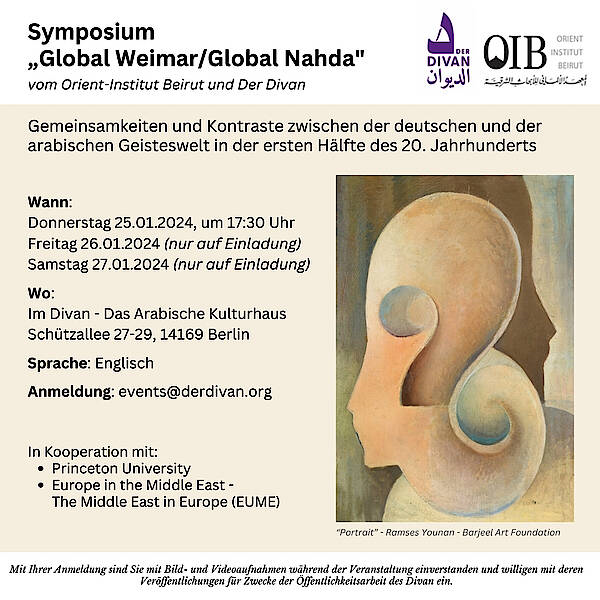
Global Weimar - Global Nahda

The “Global Nahda / Global Weimar” symposium marked the beginning of OIB's 2024 activities and initiated the institute’s collaboration with the Arab cultural center, Der Divan, in Berlin Zehlendorf. The Nahda and the Weimar Republic may be separated both in terms of time and space, but as metaphors and projects both continue to inform the present. The initiators of this comparison of the history of ideas, Simon Conrad and Peter Makhlouf from the Princeton University, identified numerous parallels, which were reflected upon and further developed at this thought-provoking and well-attended symposium.
 

We document the thematic introduction by OIB’s director Jens Hanssen.
 

"What is the Nahda?"
 

I have chosen this general question so that we can create a common basis for our experimental Weimar-Nahda comparison. Nahda is still omnipresent in public discourse in the Arab world. For a Berlin audience, however, "Weimar" is likely to evoke more diverse and intense associations. 
For the time being, we can define the Nahda as an emancipation project of Arab intellectuals in the long 19th century that lasted until the 1940s.
In the year of Kant, I naturally also ask the question "What is the Nahda?" in allusion to Kant's epochal question "What is Enlightenment?" from 1783, where Kant famously demanded that people should have the courage to "make public use of their reason in all matters". Only in this way could we humans emerge from self-inflicted immaturity into a state of freedom. However, Kant immediately restricted this freedom for citizens in office and religious authority. In Kant's normative presentation, Enlightenment is a project for responsible citizens aimed at the "dankbare Welt und Nachwelt". The community of scholars should help society to leave the past behind and create a better future. 
Literally translated, al-nahda does not mean enlightenment - that would be al-tanwir, a term that only became programmatic in the late 1980s – but rather: " rising up," "uprising," and "revival." 
On the one hand, the Arab Nahda, like the European Enlightenment, is a historical epoch with a beginning and an end (which, of course, is a matter of dispute). On the other hand, it is an ongoing, normative project for the future, based on the declared emergence from an alleged indolence or backwardness (this is also the subject of heated debate). 
The Nahda dedicated itself to reviving the Islamic-Arabic cultural heritage, especially the Golden Ages of the Abbasid Empire (until the Mongol invasion in 1258) and the Islamic-Jewish high culture on the Iberian Peninsula - "al-Andalus" (which was destroyed by the Catholic-Castilian genocide in 1492). But the Muslim, Christian and Jewish Nahdawis of the 19th century did not just see themselves as heirs to these times. They also had a great urge for innovation and reform in their social, religious, cultural and individual lives, without, however, daring to make a radical break with the status quo. This "revival-and-reform" movement was primarily driven by the rapid spread of Arabic newspapers and magazines, especially in Beirut, Cairo and Alexandria from the 1860s onwards. 
The beginning of this project has been disputed ever since Jurji Zaidan proclaimed the "new Nahda" in 1892. However, the Nahda phenomenon existed before there was even a term for it. In their hindsight, the Nahdawis themselves regarded Napoleon's conquest of Egypt in 1798 as the trigger for the coming of 'their time'. Arab nationalists and post-colonial scholars were suspicious of this external, European, colonial reference. Some of them insisted on autochthonous factors for the Nahda. They researched the 18th century in search of evidence of an Islamic enlightenment (R. Schulze), or to acknowledge the intellectual spadework of Arab-Christian scholars before 1798 (B. Heyberger, F. Kremsti). 
Nahda-critical researchers (Jabiri, Massad, Dalal), on the other hand, warn that any epistemological reference to Europe makes the history of Arab ideas appear derivative or belated. Moreover, the attempt to find Nahda precursors in the 18th century conceals those intellectual traditions that did not culminate in the Nahda and which the Nahda project arrogantly declared obsolete. 
I am not concerned here with right or wrong interpretations. According to Nietzsche, interpretation always includes claims to power. Rather, this sketch is intended to show that the Nahda represents a kind of Archimedean point for Arab modernity, on which truth claims about the Arab past and future have been balanced since the late 19th century. 
Nahda's legacy is in some ways similar to that of the two broad interpretive axes of the European Enlightenment. One axis leads from Voltaire via John Stuart Mill, and the optimistic Marx, to Habermas; and the other axis along Rousseau, Nietzsche, Heidegger and Michel Foucault. For Voltaire, the Enlightenment was characterized by the power of critics to negotiate greater freedoms with the authorities. Habermas would later celebrate this as the structural transformation of the public sphere in the 18th century. In this axis, progress has a positive connotation, and modernity is a project that is constantly being perfected. Rousseau also recognized that freedom was spoken of everywhere in his time, but he saw the developments in the 18th century as a worsening, a general alienation of man. After the Second World War, Horckheimer and Adorno spoke of an instrumentalist dialectic of enlightenment, in which "enlightenment relates to things like the dictator relates to people (whom he can) manipulate." Foucault then sees the whole of modernity as a discursive corset - Rousseau's "chains" - which the European Enlightenment has placed over all of humanity. 
The verdict on Nahda in the Arab world is roughly analogous. Some speak of an initial cultural spark for a still imperfect Arab modernity; others speak of the beginning of Arab self-alienation. There were also voices within the Nahda that were critical of certain innovations; and these did not only come from religious dignitaries and patriarchs, for whom everything was moving too fast and whose social power and authority of interpretation was felt to be eroding. 
A veritable culture war broke out between Nahdawis, for example, over the new Arabic language - which Ibrahim al-Yaziji dismissed around 1900 as a mere “newspaper language” - or what Brecht's later radio criticism called the manipulative "communication apparatus". Poets and philologists among the Nahdawis were suspicious of those journalists who allowed the magic of the Arabic language to be flattened by the printed word, and by print capitalism in general, precisely through its dissemination. In contrast, Jurji Zaydan, the newspaper entrepreneur and author of dozens of historical novels that are still widely read today, saw his language-renewal project as a bulwark against British and French cultural imperialism, which was striving to upgrade regional Arabic dialects to national languages. 
Before we think any further, we should disentangle the collective noun "Nahda" spatially and temporally. For intellectuals and scholars respond in their writings not only to other writings or world events in general, but also to events in their homeland or in the cities where they lived in exile. The first Nahda centers were Beirut, Cairo and Alexandria. Then came the Nahda exile bases: Istanbul, Paris, London, New York and – much later – Weimar Berlin. At the end of the nineteenth century, when private printing houses were founded in Damascus, Aleppo, Baghdad, Mosul, Jerusalem, Jaffa, Tanta and elsewhere, and journals appeared everywhere, the network of Nahdawis expanded deep into the provinces.
As historians, we must also divide the Nahda into different phases. Roughly speaking, until 1860, the revival of the historical and literary heritage was the driving force behind a Nahda that was mainly characterized by Christians. In that year, the civil war in the Mount Lebanon and the massacre of Christians in Damascus shocked Syrian-Lebanese scholars. Led by the polymath Butrus al-Bustani (one of Susannah Heschel's and my favorite Nahdawis), they started to devote themselves to urgent questions of reform, such as: What social order prevents "atavisms" like the violence of 1860? What is the role of the state, the Western imperialists, the educated Arab men and women, and the new economic elites? 
The third Nahdawi phase was heralded by the First World War. This was a war in which one sixth of the population in the Levant died, and after which Great Britain and France - legitimized by the League of Nations in Geneva - colonized the Arab provinces of the dismantled Ottoman Empire. In the 1920s, a new generation of Nahdawis added the struggle for independence to their repertoire, alongside their enthusiasm for cultural and social reform. Anti-colonial uprisings in Egypt in 1919, in Iraq in 1920, in Syria in 1925-27, and in Palestine in 1929 and from 1936 to 1939 challenged the old generation of Nahdawis. They had only wanted to negotiate their freedoms and state independence with the colonial powers at the green table. 
In the interwar period, the Nahdawis found it difficult to reconcile their appreciation of Western culture and democratic values with the real-life brutality of the mandate and protectorate administrations. Remarkably, this did not prevent the Nahdawis from siding with the Allies during the Second World War. In their newspapers, they condemned National Socialism as an even greater threat to Arab democratic aspirations than the British and French.
The Moroccan philosopher of history Abdallah Laroui once said that the anti-colonial liberalism of the first Nahda had the chronological misfortune of asserting itself precisely at the historical juncture when Europe was becoming illiberal and antidemocratic. 
The Republic of Weimar and the Weimar Project fell in 1933; the Nahda only fell with the Nakba in 1948. In the post-war period, German and Arab democracy projects had a difficult time to reassert themselves. But Weimar and the Nahda continue to inspire Eldorado anxieties and prospects. 
For all their difference, what do we gain by studying Weimar through a Nahda lens and the Nahda through a Weimar lens? What are the similarities and differences of the two hopeful but flawed periods and projects? Their legacies acquire a creeping sense of urgency, in the context of rightwing extremists winning elections in Germany, France, across Europe and in the United States, and in the context of war, destruction, famine and disease in the Middle East. Will we look back to the year 2024, the Kant year no less, as we now do at 1933 and 1948?
 

    • footer logo
    • footer log2
    • DATA PROTECTION DISCLAIMER
    • SITEMAP
    • IMPRESSUM
    • Rue Hussein Beyhoum 44
      Zokak el-Blat
    • +9611359423
    • sek@orient-institut.org

Follow us:

© 2023, OIB All Right Reserved / OIB Alle Rechte vorbehalten.