logo-oibr
  • OIB
    • About
    • News & Analysis
    • Director's Yearly Address
      • Vorwort des Direktors 2024
      • Director’s Address 2024
      • Vorwort des Direktors 2023
      • Director’s Address 2023
      • Director's Address 2022
      • Vorwort zum Jahresbericht 2022
    • Advisory board
    • Josef-van-Ess-Memorial-Lecture
    • Annual Reports
    • Newsletter
    • In the Media
    • Gallery
  • Events
  • Library
    • About
      • Library Team
      • History
    • OIB Catalogues
      • GoTriple
      • OPAC
      • IPAC
    • Repositories & databases
    • Online registration
    • Collection
    • OIB Library Regulations
  • Research
    • Current projects
      • The Japanese Red Army in Lebanon: Solidarity, Militancy, and Transregional Connectivity (Claudia Derichs)
      • Catastrophe, Memory & Critique
      • The ABC of Abū Bakr al-Shanawānī (d. 1610). Arabic letter semiotics on the threshold of modern times (Berenike Metzler)
      • Discourses on Statehood in Iraq (Christian Thuselt)
      • Decolonization, Cold War and the Rise of Authoritarianism in the Middle East (Carol Hakim)
      • A Literary History of Arab Futures: Enlightenment, Ruins, and Dystopia (Zeina Halabi)
      • Kant and the Non-European: Critique, Justice and Freedom
      • Global Weimar – Global Nahda (Princeton University and Orient-Institut Beirut Cooperation)
      • Critical Theory from the Global South: New Perspectives from Beirut (Sami Khatib)
      • Women and religion in post-conflict societies (Stephanie Dornschneider-Elkink)
      • From Arabic to Latin: Moving sciences of music around the Mediterranean (Rosy Azar Beyhom)
      • Abrahamic Interdependence - Relationship of the Islamic to the Jewish in Marital Law (Ahmed M. F. Abd-Elsalam)
      • Lebanon’s Art World at Home and Abroad: Trajectories of artists and artworks in/from Lebanon since 1943 (LAWHA) (Nadia von Maltzahn)
      • The New Testament quotations in Ibrahim al-Biqāʿīs (st. 1480) commentary on the Koran (Thomas Würtz)
      • BALANCE AS JUSTICE: DECONSTRUCTION OF PREMODERN ETHICS ON THE BASIS OF ḲINĀLĪZĀDE ꜤALĪ ÇELEBĪ’S AKHLĀḲ-I ꜤALĀ’Ī (FATIH ERMIŞ)
      • From Copying to Burning the Qur’an: Creating Models & Transposing Sacrality (Alya Karame)
      • Living in Limbo (Sarah El Bulbeisi)
      • Escape to Europe: Comparative Refugee Imaginaries (Markus Schmitz)
    • Previous projects
      • Cultural Policies in Lebanon: Cultural Institutions between State and Society (Nadia von Maltzahn)
      • Fictio Statis (Pierre France)
      • The Lebanese Intifada of October 17: Perspectives from Within (Birgit Schäbler)
      • Relations in the Ideoscape: Middle Eastern Students in the Eastern Bloc (1950's to 1991) (Birgit Schäbler)
      • Europe and the Middle East (Birgit Schäbler)
      • Picturing the (Un)Dead: Reflections and Deconstructions of Lebanese and Iranian "Martyrs" in Contemporary Photo-Related Art-Practices (Agnes Remeder)
      • Hierarchical Rationality of Religious Beliefs System in Islamic and Christian Theology (Qodratullah Qorbani)
      • The inimitability of the Qur’ān (i‘jāz al-qur’ān) in transconfessional contexts of the early ῾Abbāsid period (Hans-Peter Pökel)
      • Cultural Mobilities and Political Spaces (Christopher Bahl)
      • Al-Qadi al-Fadil (Stefan Leder)
      • Bedouin Syria (Johann Büssow)
      • Borrowing and lending (Jonathan Kriener, Ruhr-Universität Bochum)
      • Clergy and conflict management (Thomas Scheffler)
      • Higher Education and Citizenship in Egypt (Daniele Cantini)
      • History Writing at Lebanese Universities (Jonathan Kriener)
      • Knowledge in postgraduate studies (Daniele Cantini)
      • Mamâlik – Spatial Dynamics of Islamic Polities (Kurt Franz)
      • Media culture transformation (Hanan Badr)
      • Museums in Dialogue with the Future (Felicia Meynersen)
      • Political slogans (Nader Srage)
      • Political thought (Stefan Leder)
      • Rural societies in an age of urbanisation (Astrid Meier)
      • S.C.R.I.P.T. - Source Companion for the Research on Islamic Political Thought (Stefan Leder)
      • Talking about art – aesthetic reflection in Egypt and Lebanon (Monique Bellan)
      • Tracing an author’s library (Torsten Wollina)
      • A Literal World: Perceiving the World as a Linguistic Construction before the Emergence of the Metaphor in Arabo-Islamic Thought (Abdallah Soufan)
      • Open Arabic Periodical Editions (OpenArabicPE) (Till Grallert)
      • “Women on the streets!: a genealogy of food riots in the Middle East between the 18th and 20th centuries“ (Till Grallert)
    • OIB Seminar Series
      • Theory & Method Seminar (Zeina Halabi) By invitation only
      • The OIB Colloquium (Carol Hakim)
      • The Lebanese-Syrian Studies Colloquium (Carol Hakim)
      • The Egyptian Studies Lecture Series (Carol Hakim)
      • The Hans-Robert Roemer Fellow Lecture Series (Jens Hanssen)
      • The OIB-LAfOS Annual Lecture On Lebanese-Ottoman Studies (Jens Hanssen)
      • The Annual Joseph-Van-Ess Lecture (Jens Hanssen)
  • People
    • OIB Team
      • Directorate
      • Administration
      • Library
      • IT
      • Publications
      • Research Associates
      • Cairo Office
      • Fellows-in-Residence
      • Technical Staff
    • Academic Visitors
      • Hans Robert Roemer Fellow
      • Affiliated Researchers
      • Fellows-at-large
      • Journalists-in-Residence
    • LAWHA Team
    • Alumni
  • Publications
    • BI · Bibliotheca Islamica
      • About BI
      • Recent Issues
      • Full List
    • BTS · Beiruter Texte und Studien
      • About BTS
      • Recent Issues
      • Full List
    • OIS · Orient Institut Studies
      • About OIS
      • Recent Issues
      • Full List
    • OIB Blog
    • Extra Series
      • About
      • Recent Issues
      • Full List
    • Latest Publications
  • Academic Support
    • Calls & Grants
      • Call for papers: The Arab Graduate Students Conference (AGSC), organized by the Arab Center for Research and Policy Studies (ACRPS), has been extended to 30 October 2025
      • Call for Papers – The Many Worlds of Ahmad Shawqi: Poetry, Drama, and Cultural Legacy. American University of Beirut – May 2026 (Dates TBA)
      • The graduate programme "Post-Eurocentric Europe. Narratives of a World Province in Transformation" at the University of Konstanz calls for applications for a doctoral position. Deadline: 20.09.2025
      • Call for Early-Career Fellows of the Vienna Center for Advanced Studies (ViCAS)
      • The ERC project KNOW: Polymathy and Interdisciplinarity in Premodern Islamic Epistemic Cultures (1200–1800) invites proposals for its first international workshop
      • Call for papers – Aid Networks and Mechanisms in a Migratory Context: Europe and the Middle East (1945-1970) – Deadline: 30 June 2025
      • Call for applications for a fully funded PhD fellowship at Ghent University
      • الذكرى المئوية للثورة السورية الكبرى (١٩٢٥-٢٠٢٥) في Maison méditerranéenne des sciences de l’homme (MMSH), Aix-en-Provence
      • Call for Papers: The Making of the Lebanese Working Class, Historical Materialism, London Conference, November 2025
      • A workshop on editing Arabic texts in manuscripts organised by Farouk Jabre Center for Arabic & Islamic Science & Philosophy
      • Call for applications for the international Senior Fellowship Programme of the College for Social Sciences and Humanities, an Institute for Advanced Study based in Essen (Germany) that is part of the University Alliance Ruhr (UA Ruhr)
      • Junior social scientists working on MENA region – deadline: 4 May 2025
      • Associate Senior Lecturer in History (Middle Eastern) – Lund University
      • CALL FOR PAPERS for the Symposium ARAB-GERMAN RELATIONS IN THE MIRROR OF HISTORY
      • استكتاب للمشاركة في ندوة العلاقات العربية-الألمانية في مرآة التاريخ
      • Call for papers: Diasporas, Exiles, Migrants, and Refugees from Europe in the Middle East and North Africa in the 19th and 20th Centuries. A workshop held on July 8-10, 2025, at the Centre Marc Bloch, Berlin, Germany
      • IEG Fellowship - The Leibniz Institute of European History in Mainz call for applications for one fellowship starting in September 2025. Application Deadline: April 14, 2025
      • Faculty vacancy announcement – The City University of New York Faculty Open Rank - Open Rank, Palestinian Studies Cluster Hire/ Art & Humanities
      • Call for Proposals for a conference on the Lebanese Civil War on the 50th anniversary of its outbreak
      • B2B - Call for Papers - Orient-Institut Istanbul
      • Call for submissions: Palestine Studies, German Studies: Special issue of The German Quarterly
      • Call for Applications: Why Location Matters: Research in the Arab World | دعوة إلى تقديم الطلبات: أهمّية مواقع الأبحاث في العالم العربي
      • Stellvertretender Direktor(in)
      • Wissenschaftlicher Mitarbeiter(in) (German version)
      • Research Associate positions
      • Bibliotheksleiter(in)
      • MESA/ACSS/OIB Call for applications
      • Call for applications: MECAM Fellowship Programme 2025-2026
      • Call for applications: Postdoctoral Fellowship Opportunity for Researchers (f/m/d) From Palestine and Lebanon
      • Call for applications: Khaled al-Asaad Solidarity Funds for researchers in danger
      • Call for Papers International and Interdisciplinary Conference: "Philosophy and Poetry in Islamic Contexts"
      • Call for applications: PhD position at the ERC-KNOW
      • Call for applications: Postdoc position at the ERC-KNOW
      • Call for the Winter School "Reading and Analysing Ottoman Manuscript Sources,” March 17-21, 2025, Rethymno, Institute for Mediterranean Studies/FORTH, deadline December 15, 2024
      • MECAM Traveling Academy for 2024-2025
      • Link zum Call for Sessions (in englischer und deutscher Sprache)
      • ACSS-FMSH Short-Term Postdoctoral Mobility Fellowship Program in the Social Sciences and Humanities, deadline: Dec 09, 2024
      • Call for applications: Scholarship for Lebanon and Turkey-based researchers for the project "Removal Infrastructures for Syrians in Lebanon and Turkey," deadline: 19/06/2024
      • Call for applications: 12 Doctoral Positions at the graduate program "Post-Eurocentric Europe: Narratives of a World Province in Transformation” at the Department of Literature, Art and Media studies of the University of Konstanz, deadline: 30/06/2024
      • Resident scholar program for Lebanon-based and Lebanese scholars at the Finnish Institute in the Middle East
      • Marie Curie Fellowships
      • ACSS Early Career Fellowships
      • Gerald D. Feldman travel grants
    • Vacancies
      • Residential Postdoctoral Fellowships
      • Residential Doctoral Fellowships
      • OIB Research Relief Fellowships 2022/2023
    • Academic Visitors
      • Affiliated Researchers
      • Fellows-at-large
      • Journalists-in-Residence
      • Hans Robert Roemer Fellow
    • Praktika/Interships
      • OIB-Praktika 2025 (German version)
      • OIB Internships 2025 (English version)
    • Guest rooms
Back to News & Analysis

El Alamein: Between Egypt & Germany


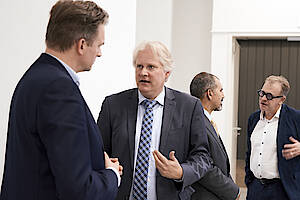
On Thursday 31 October 2024, the Museum Fridericianum in Kassel hosted a conference dedicated to exploring the historical, cultural, and architectural significance of the memorial site of El Alamein in Egypt. The event brought together scholars and experts to examine multiple narratives surrounding this site, focusing on its implications for memory culture in both Egypt and Germany. By addressing the intersection of history, politics, and societal remembrance, the event sought to foster a deeper understanding of how the battles of El Alamein are remembered and interpreted today. Organised in collaboration with the Orient-Institut Beirut, the Volksbund Deutsche Kriegsgräberfürsorge (German War Graves Commission), the documenta-Institut and the Landeszentrale für Politische Bildung, the evening was part of the cross-foundation lecture series "Ends of War – International Perspectives on the Second World War" initiated by the Max Weber Foundation. The programme featured three distinguished speakers offering diverse perspectives on the legacy of El Alamein: Emad Helal from Suez Canal University presented the Egyptian perspective on the battles, highlighting often overlooked local experiences and the role of Egyptian soldiers. Christian Fuhrmeister of the Central Institute for Art History in Munich addresses the importance of the El Alamein war cemetery within the context of German memory culture, while Dieter Pohl from Alpen-Adria University explored the international impact and historical significance of the battles. The evening started with opening remarks from Andreas Hoffmann, CEO of documenta and Museum Fridericianum GmbH, along with Kassel’s Mayor Sven Schoeller and Dirk Backen, Secretary General of the Volksbund Deutsche Kriegsgräberfürsorge e.V., as well as Felix Münch, Deputy Director of the Hessian State Center for Political Education. Moderated by Liliana Gómez of the University of Kassel, the event concluded with a panel discussion, providing space for an in-depth exchange of ideas and perspectives. The participants analysed the ways in which Egypt and Germany remember the battles of El Alamein, which were crucial to the course of World War II in North Africa. While these battles are widely recognised in Germany as a crucial military turning point, the Egyptian perspective, including the experiences of Egyptian soldiers, has been largely marginalised. The lectures and subsequent discussions critically examined the political and societal dimensions of this historical memory, addressing the broader question of how historical sites like El Alamein are incorporated into each country’s narrative of the past. In Germany, the war cemetery near the battlefield serves as a focal point of memory, reflecting a tradition of institutionalised commemoration. In Egypt, the legacy of El Alamein is closely intertwined with the region’s colonial history and its role in global conflicts, thereby providing a distinct framework for understanding the site’s significance. A further key focus of the evening was the architecture of the El Alamein war cemetery, constructed in the 1950s by the Volksbund Deutsche Kriegsgräberfürsorge in collaboration with the German government. Designed as a Totenburg (castle of the dead) and inspired by the medieval Castel del Monte, the cemetery embodies the memorial strategies of postwar Germany. Its austere, depersonalized architecture reflects a shift in commemorative practices, aligning with both the emerging identity of the Federal Republic and the broader tradition of imperial monumentalism. Consequently, the cemetery can be considered both a historical and architectural landmark, prompting reflection on the politics of memory and the ways in which sites of war are remembered and constructed. The event provided a valuable opportunity for international scholars to engage in critical dialogue and reflect on the shared and divergent memory cultures of Egypt and Germany. The interdisciplinary approach highlighted the necessity of revisiting historical sites in order to gain a deeper understanding of their role in shaping contemporary identities and political discourses. Events of this nature facilitate a nuanced comprehension of the World War II’s multifaceted legacies and the ways in which they continue to resonate across diverse societies and cultural contexts. As a result, they emphasize the enduring significance of memory studies in enabling cross-cultural understanding and critical engagement with the past.

For more info:
https://vimeo.com/1040409029 
https://endsofwar.hypotheses.org/924


Click on any of the photos above for a full-size view
 

    • footer logo
    • footer log2
    • DATA PROTECTION DISCLAIMER
    • SITEMAP
    • IMPRESSUM
    • Rue Hussein Beyhoum 44
      Zokak el-Blat
    • +9611359423
    • sek@orient-institut.org

Follow us:

© 2023, OIB All Right Reserved / OIB Alle Rechte vorbehalten.