Affiliated Researcher
Email: susan.abraham@virginia.edu
February-June 2025
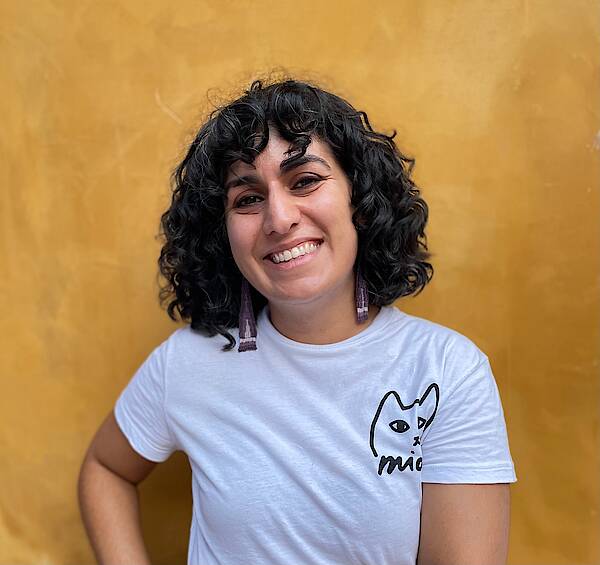
Susan Abraham is an advanced Ph.D. Candidate in the Department of Spanish, Italian, and Portuguese at the University of Virginia (U.S.A). She is a scholar of the history and culture of early modern Spain in connection with North Africa and the wide Mediterranean, focusing on the textual production of exiled Moriscos—Muslims forcibly converted to Christianity—in Tunisia. Her research is animated by a concern with how literature, language, and translation capture movement and displacement across the Mediterranean. With this point of inquiry at the center of her work, she explore how ideas travel from one shore of the Mediterranean to another, how they are adapted and transformed in the process, and their impact once they reach new domains.
In 2024 her dissertation project, “Narrating Faith Across the Straits: Morisco Manuals of Faith in Tunis and the Early Modern Mediterranean,” was awarded a Charlotte W. Newcombe Doctoral Dissertation Fellowship for ground-breaking work addressing questions of ethical and religious values in the humanities and social sciences.
Project Description
Narrating Faith Across the Straits: Morisco Manuals of Faith in Tunis and the Early Modern Mediterranean
My work is dedicated to broadening the scope of early modern Spanish literature by underscoring the textual interventions and contributions of Moriscos— Iberian Muslims forcibly converted to Christianity—in sixteenth- to seventeenth-century Tunisia. In my research I examine the discursive constructions of religious, racial, and ethnic identities in early modern Spain and North Africa, specifically analyzing how Moriscos narrated the experience of displacement to cultivate community and cultural continuity in diaspora. To do so I examine Morisco didactic miscellanies, doctrinal treatises, and polemical poetry written in Arabic and Spanish that are archived in Spain and Tunisia. Further, I put these understudied texts into conversation with early modern Spanish literature and Arabic writings like qasida poetry, hagiographies, Qur’anic and exegetical (tafsīr) sources, and Islamic jurisprudence (fiqh). This multi-lingual framework puts into relief how early modern Morisco writing in diaspora was shaped by experiences of connectivity and interaction and, therefore, critically responds to scholarship that has subsumed this corpus under the rubric of Spanish literature while portraying its authors as passive recipients of a European literary canon. I argue that Moriscos creatively engaged classical Arabic and North African Islamic traditions while strategically adapting literary forms and tropes rooted in Christian Europe to forge a narrative ethics reflecting their diaspora experience in the Mediterranean